
The Wild Hunt Approaches
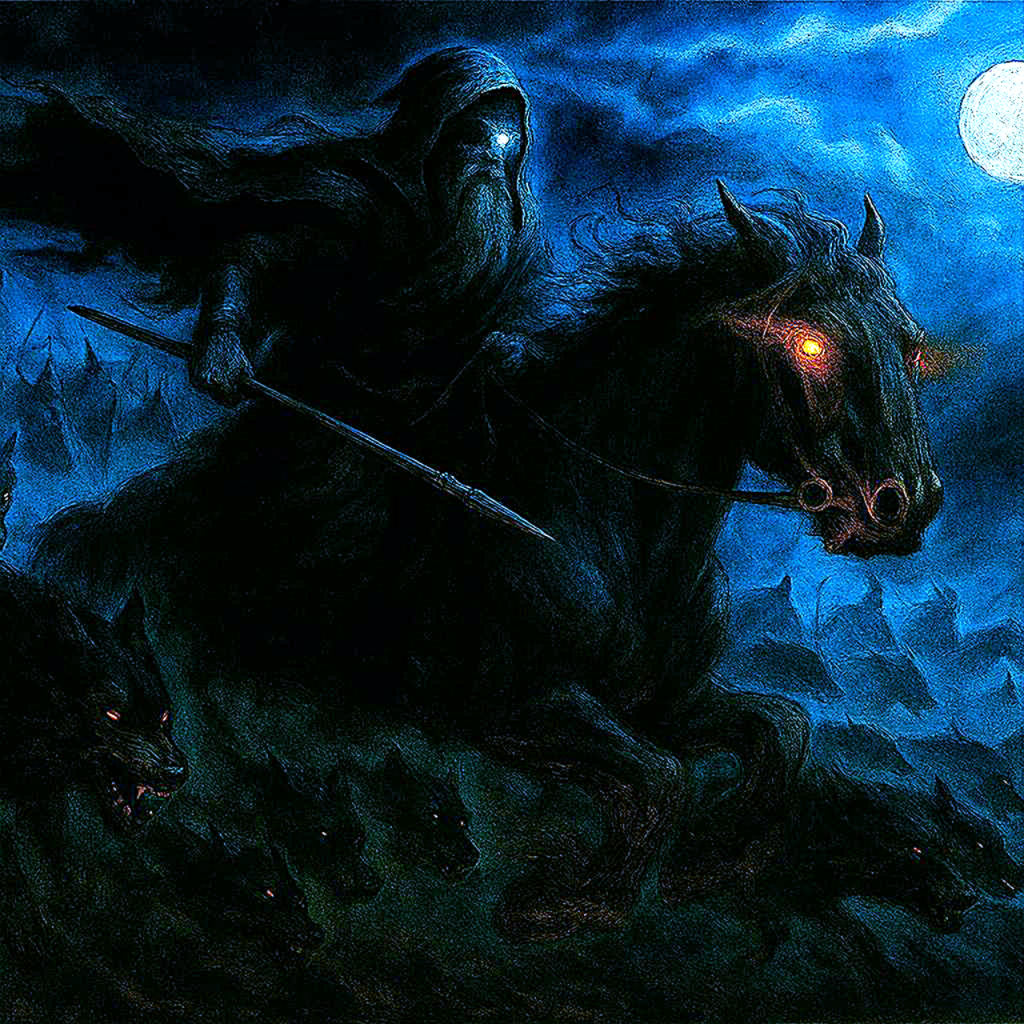
Odin and the Wild Hunt (AI generated)
The idea of the Wild Hunt is found among many cultures of the old world and particularly among the people of Northern Europe. The beliefs vary greatly, but basically the Wild Hunt is a procession or a hunting party that stalks the night during the darkest part of the year.
In older versions it may have been made up mostly of predatory animals, but later stories described a combination of human and non-human hunters, running or riding together. What all versions seem to have in common, and what makes it so spooky, is the belief that this was not a band of normal, mortal beings, but a spectral procession filled with spirit beings. It’s a supernatural hunting party.
In some places it was thought to begin around the time of Halloween and end around Midwinter (Feb 2), with its peak at the Winter Solstice. These were the times when the Veil, the line between the mortal world and the spirit world, were said to be at their thinnest — a time when a frenzied group of spiritual predators might easily pass into our realm.
As noted above, it also happens to be the period when nights are at their longest and daylight hours at their shortest. Some might even argue that the Hunt is an embodiment of winter nights — harsh, dark, and dangerous.
Even so, in the older tales there is a sense that the Hunt was something that inspired awe and respect. People would sometimes even leave offerings out for the ghostly riders. With the arrival of Christianity, however, the myth was given a more sinister spin. It was characterized by the Church as an evil force filled with demonic beings and damned souls.
One aspect of these stories that is given a lot of attention is who leads the Hunt. There is usually a rider at the head of the party, the tip of the spear, so to speak. Often it is Odin, the Norse All-Father himself. Other times it is Krampus, the Christmas anti-hero, or mythical female figures like Holda or Berchta. It might be a mortal nobleman who was said to have engaged in wrongdoing during life and is consigned to lead the wild hunt after they died as a kind of punishment or atonement. In later times it could even be the Christian Devil.
A common theme of these tales is that you don’t want to be caught outside after dark at this time of year, especially not in the wilds. The Hunt can sweep in unexpectedly and either mow you down or carry you away.
In that spirit, here is a retelling of a story based on old folktales about the Hunt.
The Miller’s Son
Long ago, when the forests were deeper and the winds blew wild across the land, there was a miller’s son who was visiting a friend on a winter’s evening. Late in the night, after lingering a bit too long beside the warm hearth, he ventured out into the cold. The moon was veiled above and the path through the woods submerged in darkness. Yet he knew the way home well enough, and set out on his way.
At first the night was calm, the rhythm of his own footfalls the only sound. But soon he noticed the breeze growing restless as it tussled the boughs above his head. Steadily it picked up until a great wind tossed his cloak, chilly air biting into the skin on his cheeks and making his eyes water.
In the distance he heard a low rumble like thunder. But as the sound grew closer, swelling into a mighty roar, he recognized distinct sounds within the cacophony.
The baying of hounds. The rumble of hooves. The blast of horns.
The miller’s son froze in place. He had heard tales of a spectral procession sometimes seen riding over wild places during the darkest time of the year. It was said that this band of hunters stalked souls that had strayed from the spirit world, preying upon monsters and men and anything else unfortunate enough to stand in its path. They called it the Wilde Jagd. The Wild Hunt.
With not a moment left to spare, the miller’s son ducked down behind a tree. He watched as a terrible company swept into view — riders cloaked in storm, astride ghostly mounts with eyes burning like embers. A frenzied pack of hounds with mouths of fire ran at their heels. And in the lead rode a tall figure, cloaked in shadow, his single eye gleaming brighter than the moon.
The miller’s son closed his eyes tight, praying that the riders would pass him by. But the leader reined in his black steed and bent low. His voice was like wind tearing through the rafters of a house as he bellowed, “Will you ride with us, boy? Or be trampled down beneath our hooves?”
The miller’s son opened his eyes and gazed into the rider’s ancient face. His heart quailed within his chest, yet he found the strength to force the words past his lips. “I will ride.”
A hand strong as iron seized him, and in a heartbeat he was astride a furious horse, soaring through the storm. Around him swept the Hunt — the restless dead, kings of old, thieves and warriors, all bound to the company. He saw some in chains, dragged down by their greed, and others riding free as if the storm itself carried them.
Through forest and field, over sea and mountain they flew, and the boy’s eyes were wide open now. He witnessed savage longing, sacred vengeance, and severe mercy. He saw the shape of human lives and how every deed vibrates through eternity. He saw the thin curtain that parts the living from the dead. He saw the truth of fate, and the folly of pride, and how every soul finds its place at last in the great web of being.
All of this he saw and more, until at last, as dawn’s pale light touched the earth, the Hunt drew still upon a lonely moor. The one-eyed rider set the miller’s son down and spoke. “You have seen what others fear to dream. Guard your tongue well. A fool’s mouth brings ruin, but the wise can offer counsel even in silence.”
Then the Hunt swept away, horns echoing into nothingness.
The eyes of the miller’s son were never the same after that day, nor his ears. He was blind to the gleam of gold and silver, deaf to songs that praised the exploits of kings and nobles. But he was keenly attuned to birdsong, to the babble of streams and the laughter of children. He never missed a sunrise or a sunset. He would spend hours watching trees sway in the breeze.
The people of the village would sometimes see him walking along the riverbank, singing to himself, or pointing to the sky and laughing like a madman.
Some said he could peer through the Veil itself and see the pattern of threads that lay beneath our world.
But the miller’s son never spoke of that night. Never — except to remind those who asked that the forest is full of mysteries, and that wisdom is found by those who dare to face the storm.