
Orion the Hunter, and Other Predatory Giants

The constellation Orion
I ran into an old friend this morning, in the pre-dawn hours — a figure in the night sky shaped like an hourglass with three bright stars forming a belt across the middle. I am, of course, talking about Orion, one of our most recognizable constellations.
In the upper Midwest, Orion is mostly visible during the winter months. The hunter’s appearance over the horizon in Autumn is a sign that colder weather is on its way, so in my mind, he is associated with northern winter. Though I’m not aware of any explicit connection between the constellation and Northern European stories of the Wild Hunt, there is certainly some thematic resonance there. As a matter of fact, Orion happens to be at his peak elevation at midnight around the Winter Solstice, precisely the time when it’s said the Wild Hunt is at its frenzied climax. It’s not hard to imagine Orion leading a ghostly pack of hunters as they stalk prey across the frozen landscape.
Many cultures throughout the world have some version of this constellation. In Mesopotamia, it seems to have been associated with the figure of Gilgamesh, a mythological Sumerian king and monster slayer. In China, it has been called Shen, a great hunter or warrior. In parts of the Arabic world, it is known as al-jabbar, “the giant.” Orion has even been associated with the biblical figure of Nimrod, said in Hebrew scriptures to be a mighty hunter “in the face of” the LORD. Despite the variation, there are obvious commonalities. This has led some to theorize a very old origin for the association of the constellation with a hunter/warrior/giant figure, the idea being that early humans carried these stories with them as they migrated throughout the world.
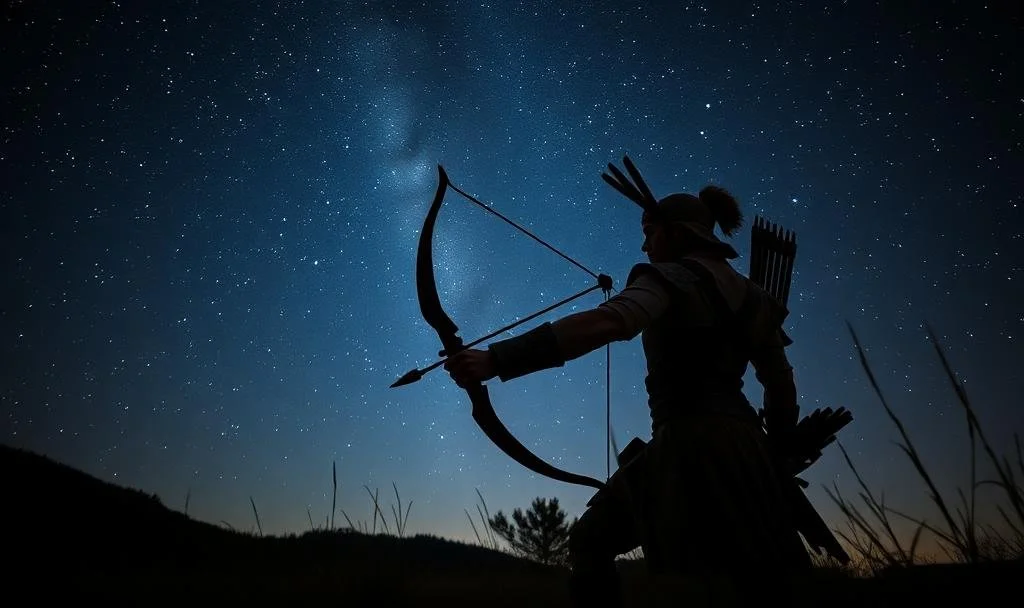
Orion the Hunter (AI generated image)
But for most of us, the stories we know come from ancient Greece. In these stories, Orion is the quintessential mighty hunter. He is sometimes presented as a hero, sometimes a brute. There are many versions with sometimes conflicting storylines. He befriends Artemis, Goddess of the Hunt, or angers her by his arrogance. Artemis is tricked into killing Orion by her brother, Apollo, and mourns his death — or she kills him out of anger when he tries to force himself on her. Often, it is the Earth Mother, Gaia, who sends a scorpion to kill Orion for bragging that he will hunt and kill every animal on the planet. Upon death, the gods place Orion in the sky for all to see — either to honor him, or as a warning. Maybe both.
The variety found within these stories, even within the Greek tradition, demonstrates how fluid myths can be. They are living things, adding or subtracting elements, taking on different emphasis depending on the teller, and varying in meaning based on the culture or the time in which they are told.
Yet there are sometimes threads that form the core of a myth, and that’s the case with Orion. He is often depicted as the perfect male specimen — big, strong, brave, handsome. But, if anything, his story warns of an overabundance of these qualities. There does seem to be a sort of “toxic masculinity” aspect to many of his stories. Confidence can easily become arrogance. Strength can lead to aggression or even predatory behavior.
That, it’s worth noting, is exactly what Orion is. A predator — with all of the modern connotations that word implies. Given the fact that Orion’s story is largely about the masculine ideal run amok, it’s notable that a female figure (Gaia or Artemis) is normally the one to put the big guy in his place. It takes a strong female energy to check the more toxic masculine extremes.
But even beyond the toxic masculinity theme, there is a deeper thread that seems to have particular resonance for our times. Orion embodies the notion of “might makes right,” the idea that those with power are entitled to do as they wish, simply because they can.
I don’t need to tell you, dear reader, that we are living in a time where “might makes right” is the primary modus operandi. Powerful nations, led by powerful men, impose their will on the rest of the world. Our own populace embraces authoritarianism and fascism. Income inequality is reaching an absurd level, with the existence of trillionaires (trillionaires!) almost upon us. We are increasingly lorded over by a despotic oligarchy that takes, takes, takes, picking away at the bones of our dying planet.
This is a time when we desperately need stories about predatory giants — and the goddesses who tear them down.
Originally published in Illumination.